Finding an ear, nose, and throat specialist in Kyoto as an expat is one of those healthcare tasks that sounds simple until you actually try to do it. You’ve got a blocked ear, a sinus infection that won’t quit, or a sore throat that’s been dragging on for two weeks — and suddenly you’re googling in circles, unsure whether the clinic down the street sees foreign patients, whether anyone speaks English, or whether your insurance card even works here. Most Japanese ENT clinics are excellent, but their websites are in Japanese, their phone lines are answered in Japanese, and the intake forms you’ll be handed at the door are definitely in Japanese. Add to that the confusion around Japan’s national health insurance system, the difference between a jibiinkōka (耳鼻咽喉科) specialist and a general practitioner, and the fact that “English-friendly” can mean anything from fluent to “we have a Google Translate tab open” — and it’s a lot. This page exists to cut through that. We’ve listed the ENT clinics in Kyoto that can actually communicate with English-speaking patients, and we’ve included the practical stuff you need to know before you show up.
What to Expect at a Kyoto ENT Clinic
Japanese ENT clinics — look for the sign that says 耳鼻咽喉科 (jibiinkōka) — are standalone specialist clinics you can visit directly without a GP referral in most cases. That’s actually a nice feature of the Japanese system: you don’t need to go through a gatekeeper to see a specialist.
Most clinics operate on a first-come, first-served basis or a combination of walk-in and same-day online reservations. Wait times can be significant at popular clinics — arriving early in the morning (before 9am) is a common tactic locals use. Bring your health insurance card, your residence card (zairyu card), and cash. While most clinics now accept cards, cash is still the safer bet.
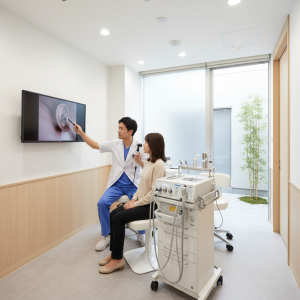
At your first appointment, you’ll fill out a paper intake form covering your symptoms, medical history, and allergies. The examination itself is typically efficient — Japanese doctors are thorough but fast. Expect an endoscope or otoscope examination, and possibly a hearing test depending on your symptoms. The doctor will usually prescribe medication on the spot, which you fill at a nearby pharmacy. A standard ENT visit with national health insurance typically costs between ¥1,500 and ¥3,000 out of pocket for the consultation, plus pharmacy costs.
English-Speaking ENTs in Kyoto
The honest reality is that fully English-fluent ENT specialists are rare in Kyoto. The clinics listed here have been verified as genuinely accessible for English-speaking patients — not just clinics that have “English available” buried in their website footer. We’re actively adding more providers as we verify them, so check back if you don’t see one near you.
Shibata Clinic — Demachiyanagi
Shibata Clinic is one of the more accessible ENT options in Kyoto for expats, with fluent English available — which puts it in a genuinely small category among specialist clinics in the city. It’s located a 7-minute walk from Demachiyanagi Station on the Keihan Line, making it reasonably convenient if you’re coming from central Kyoto or the eastern side of the city. It’s a highly-rated facility focused specifically on ear, nose, and throat conditions, so you’re not dealing with a generalist who happens to see ENT patients — this is their specialty, and that tends to show in the quality of the examination.
We’re in the process of verifying and adding more English-friendly ENT clinics across Kyoto. If you know of one that should be listed, get in touch.
How to Book an ENT Appointment in Kyoto
Your options are phone, walk-in, or online booking — and which one works depends on the clinic.
Online booking is increasingly common and is honestly the easiest route if your Japanese isn’t strong. Many clinics use booking systems like LINE or dedicated reservation pages. Check the clinic’s KantanHealth profile for direct links.
Phone booking is still the norm at some clinics. If you need to call, this phrase gets you started: 「英語を話せる先生はいますか?」 (Eigo wo hanaseru sensei wa imasu ka?) — “Is there a doctor who speaks English?” You can also say 「予約をしたいのですが」 (Yoyaku wo shitai no desu ga) — “I’d like to make an appointment.”
What to bring:
- Your health insurance card (国民健康保険証 or employer insurance card)
- Your residence card (在留カード)
- Cash (¥3,000–¥5,000 should cover most visits)
- A list of any current medications and known allergies, written in English is fine
When you arrive, you’ll be given a paper intake form. If the form is entirely in Japanese, a document translation tool like Jozu lets you upload the form and get a readable translation — useful for working through medical history sections accurately before you hand it back.
Insurance and Costs
If you’re a registered resident of Japan, you should be enrolled in the National Health Insurance (NHI / 国民健康保険) system, which covers 70% of most medical costs. That means a standard ENT consultation typically costs you ¥1,500–¥3,000 out of pocket, with prescriptions adding another ¥500–¥2,000 depending on the medication. More involved procedures like ear irrigation or nasal endoscopy may cost a bit more but are still very reasonable by international standards.
If you’re here on a short-term visa, traveling, or not yet enrolled in NHI, you’ll be paying full price — which is still often cheaper than a co-pay in the US or Australia, but it adds up. This is where expat travel insurance earns its keep. SafetyWing is a popular option among digital nomads and short-stay expats — it’s designed for people living abroad rather than just tourists, and it covers outpatient visits including specialist consultations. Worth having active before you need it, not after.
One practical note: always ask the clinic to provide an itemized receipt (ryōshūsho / 領収書). You’ll need this for any insurance reimbursement claim.
Finding the Right Clinic for You
A few quick questions to help you decide:
- Do you need fluent English? Prioritize clinics explicitly listed as fluent — basic English at a clinic means the doctor can handle simple vocabulary, but a detailed symptom history or follow-up conversation may hit a wall.
- Is this urgent? Walk-in availability varies. Arriving early (before opening) dramatically reduces wait times at most clinics.
- Where are you based in Kyoto? Demachiyanagi is well-connected via the Keihan Line and is accessible from central Kyoto without much hassle, but factor in your own commute.
- Are you a resident or visitor? This affects your insurance situation significantly — see the section above.
And if you’re planning to stay in Japan longer-term, it’s genuinely worth putting some time into learning basic medical Japanese. Being able to describe your symptoms clearly — even imperfectly — makes a real difference in how smoothly appointments go. iTalki is a good place to find Japanese tutors who can walk you through medical vocabulary and appointment phrases in a way that’s actually practical, not just textbook.