Tweaking your knee on a day hike up Miyajima, throwing out your back moving into your new Hiroshima apartment, or dealing with a nagging shoulder injury that finally needs proper attention — orthopedic issues don’t wait for a convenient moment, and finding the right clinic in Hiroshima as an expat can feel genuinely daunting. The core friction isn’t just the language barrier, though that’s real. It’s the whole system: figuring out whether you need a referral, whether the clinic accepts your insurance card, whether anyone on staff can actually explain your diagnosis in English, and whether “English-friendly” on a website means fluent consultation or just a translated intake form. Hiroshima has solid orthopedic care — university hospitals, specialist clinics, and neighborhood seikei geka (整形外科) offices — but navigating it without a local guide or a Japanese-speaking partner is genuinely hard. This page exists to cut through that confusion, give you a realistic picture of what to expect, and point you toward options that won’t leave you nodding along to a diagnosis you didn’t understand.
What to Expect at a Hiroshima Orthopedic Clinic
Japanese orthopedic clinics — listed as 整形外科 (seikei geka) on signage and maps — range from small neighborhood practices to large hospital departments. Most operate on a first-come, first-served basis for walk-ins, though larger facilities increasingly offer online or phone reservations. At your first appointment, expect to fill out a paper intake form covering your symptoms, medical history, and insurance details. Bring your National Health Insurance (NHI) card if you have one — it dramatically reduces your out-of-pocket cost. Wait times vary: a busy hospital department might mean two hours in the waiting room, while a smaller clinic on a quiet morning could see you in twenty minutes.
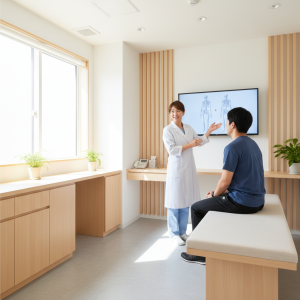
The appointment itself typically involves the doctor asking about your symptoms, a physical examination, and often an X-ray on the same visit — Japan’s clinics are well-equipped and efficient in that regard. MRI referrals are common for soft tissue injuries. Costs without insurance run roughly ¥3,000–¥8,000 for an initial consultation including basic imaging. With NHI covering 70%, your share drops significantly. English availability is the wildcard — don’t assume; always check before you go.
English-Speaking Orthopedics in Hiroshima
We’re building out our Hiroshima orthopedics directory actively and will be adding verified, English-friendly providers as we confirm their details. If you’ve had a good experience at an orthopedic clinic in Hiroshima as an English speaker, let us know — community tips are how this list grows.
In the meantime, here are some practical approaches for finding orthopedic care in Hiroshima right now:
- Hiroshima University Hospital (広島大学病院) in Kasumi has departments with international patient experience and is your best bet for complex cases or if you need an English-speaking physician — call their general inquiry line and ask about the orthopedics department specifically.
- Hiroshima City Hospital (広島市立広島市民病院) near Funairi-kawaguchi Station handles a wide range of orthopedic cases and has handled international patients before, though English fluency varies by staff member.
- Neighborhood seikei geka clinics around Hiroshima Station, Hatchobori, and Nishi-Hiroshima are plentiful and often faster for straightforward issues — Google Maps searching “整形外科” near your location is surprisingly effective, and Google Translate’s camera function can help you decode the signage.
We’ll be listing verified, expat-reviewed orthopedic providers here as our Hiroshima directory grows. Check back regularly — we’re adding clinics on an ongoing basis.
How to Book an Orthopedic Appointment in Hiroshima
Here’s a realistic step-by-step for getting yourself seen:
- Step 1 — Find your clinic. Use this page, Google Maps (search 整形外科 + your neighborhood), or ask your employer’s HR department if they have a recommended provider list.
- Step 2 — Call ahead. Even for walk-in clinics, a quick call to confirm they can accommodate an English speaker saves a wasted trip. Try: “Sumimasen, eigo wo hanaseru kata wa irasshaimasu ka?” (すみません、英語を話せる方はいらっしゃいますか?) — “Excuse me, is there someone who speaks English?”
- Step 3 — Online booking. Larger hospital departments increasingly use systems like Medicalpass or their own portals. If the booking page is in Japanese, Jozu is useful here — you can upload Japanese medical forms, registration documents, or discharge summaries and get them translated and saved, which helps enormously when you’re filling out paperwork you can’t read.
- Step 4 — What to bring. Your NHI card (or private insurance card), your residence card (zairyu card), a list of any current medications in both English and Japanese if possible, and your symptoms written down clearly.
- Step 5 — At the clinic. Arrive a few minutes early. The reception process involves paperwork first, then waiting. Don’t be surprised if the doctor’s English is limited — come prepared with your symptoms written down.
Insurance and Costs
If you’re a registered resident in Japan, you should be enrolled in National Health Insurance (NHI / 国民健康保険), which covers 70% of most medical costs including orthopedic consultations, X-rays, and physical therapy. Your out-of-pocket share for a standard orthopedic visit typically lands between ¥1,000 and ¥3,000, with MRI costs running higher (your share might be ¥5,000–¥10,000 depending on the facility).
If you’re visiting Japan or haven’t yet enrolled in NHI, you’ll be paying full price — which is still reasonable by Western standards but adds up quickly for imaging or follow-up visits. This is where expat travel insurance earns its keep. SafetyWing’s Nomad Insurance is a popular option among long-term travelers and digital nomads — it covers emergency medical care including orthopedic injuries at a reasonable monthly rate, and it’s designed for people moving between countries rather than standard tourists. Worth looking at before you need it rather than after.
Keep all your receipts and any documents from your visit — you may be able to claim reimbursement through your insurer, and having translated records helps significantly when submitting claims.
Finding the Right Clinic for You
A quick framework to narrow things down:
- Need fluent English? Go for a university hospital or a clinic with a confirmed English-speaking doctor — don’t gamble on “some English” for a complex diagnosis.
- Straightforward injury, just need to be seen quickly? A neighborhood seikei geka clinic near Hiroshima Station or Hatchobori will typically get you in faster than a hospital department.
- Ongoing treatment or rehab? Consistency matters — find a clinic you can get back to easily, ideally near your home or workplace rather than across the city.
- Visiting and not a resident? Sort your travel insurance first, then head to a hospital with an international patient desk.
One genuinely useful thing you can do before any medical appointment in Japan: learn a handful of basic phrases for describing pain and body parts. It sounds small, but being able to say where it hurts and how it feels — itai (痛い, it hurts), hidari hiza (左膝, left knee), ugoku to itai (動くと痛い, it hurts when I move) — makes the whole experience smoother for you and the doctor. iTalki is a good resource for this if you want a structured lesson with a native Japanese tutor focused on practical, medical-context vocabulary rather than textbook Japanese.
Hiroshima’s healthcare infrastructure is genuinely good — the challenge is always the navigation, not the quality of care. As our directory fills out with verified orthopedic providers, this page will become a much more direct resource. For now, the framework above should give you enough to move confidently rather than anxiously the next time you need to get a joint, bone, or muscle looked at properly.