You’ve twisted your ankle on a cobblestone near Nakasu, thrown out your back lugging luggage up the stairs at Hakata Station, or maybe that old knee injury has flared up again — and now you need an orthopedic clinic in Fukuoka. Simple enough, right? Not quite. Even in a city as international-friendly as Fukuoka, finding a musculoskeletal specialist who actually speaks English takes more than a Google search. Most clinic websites are Japanese-only, online booking systems often don’t accept non-Japanese characters, and calling ahead to ask about English staff can feel like a gamble. Then there’s the insurance question — does your expat plan cover this? Do you need a referral? Is this the kind of thing you can walk into, or do you need to book weeks in advance? This page exists to cut through that friction. We’ll walk you through what to expect at a Fukuoka orthopedic clinic, how to actually get an appointment, and what it’s going to cost you — so you can focus on getting better, not decoding the system.
What to Expect at a Fukuoka Orthopedic Clinic
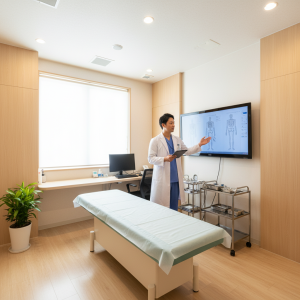
Orthopedic clinics in Japan — called 整形外科 (seikei geka) — handle everything from sports injuries and fractures to back pain, joint problems, and rehabilitation. They’re generally well-equipped, with X-ray facilities almost always on-site, and wait times at smaller neighborhood clinics can actually be quite short if you go mid-morning on a weekday.
Your first visit will typically involve filling out a paper intake form (in Japanese, usually — more on that below), a brief consultation, and often an X-ray before you even see the doctor. The appointment itself can feel fast by Western standards — Japanese clinics tend to be efficient to the point of brisk. Don’t be surprised if the actual face-time with the doctor is 10 minutes or less.
If you’re enrolled in Japan’s National Health Insurance (NHI), you’ll pay roughly 30% of the total cost at the counter. A typical orthopedic visit — consultation plus X-ray — runs somewhere between ¥2,000 and ¥5,000 out of pocket with NHI. Without insurance, expect to pay the full amount, which is still often reasonable by international standards. Bring your insurance card, a photo ID, and ideally your residence card if you have one.
English-Speaking Orthopedics in Fukuoka
We’re actively building out our directory of English-friendly orthopedic clinics in Fukuoka, and providers are being added regularly. If you know a clinic that deserves a spot here — or you’re a provider who wants to be listed — get in touch with us. In the meantime, the sections below on booking, insurance, and navigating the system will help you find and access care even without a pre-vetted list.
Check back soon — we’re adding Fukuoka orthopedic providers to the directory on an ongoing basis.
How to Book an Orthopedic Appointment in Fukuoka
Here’s a practical step-by-step for getting yourself in the door:
- Search first, call second. Look up clinics near you using Google Maps with the term 整形外科 福岡 (seikei geka Fukuoka). Check their hours and whether they mention English support anywhere on the site.
- Call to confirm English availability. It’s worth a quick call before showing up. A useful phrase: 「英語を話せるスタッフはいますか?」(Eigo wo hanaseru sutaffu wa imasu ka?) — “Do you have English-speaking staff?”
- Arrive early for your first visit. New patient paperwork takes time, and Japanese clinics often process walk-ins in arrival order. Getting there 15–20 minutes before opening can make a real difference.
- Bring the right documents. Your NHI card (if you have one), your residence card, and any relevant medical history — especially if you’ve been seen for this issue before.
- Deal with the paperwork. First-visit forms are almost always in Japanese. If you receive discharge summaries, referral letters, or prescription notes you can’t read, Jozu lets you upload Japanese medical documents and get them translated — useful for keeping track of your own care across visits or clinics.
- Online booking: Some larger clinics have online systems, but many don’t support non-Japanese input. Phone is often more reliable for expats.
Insurance and Costs
If you’re a resident of Japan enrolled in National Health Insurance (NHI), orthopedic care is covered at the standard 70/30 split — you pay 30% of the official fee schedule. For a typical first visit with consultation and X-ray, that’s usually somewhere between ¥2,000–¥5,000 depending on what’s done. Rehabilitation sessions, if needed, are similarly affordable under NHI.
If you’re a short-term visitor or haven’t yet enrolled in NHI, you’ll be paying out of pocket — though costs in Japan are still often lower than you’d expect compared to the US or Australia. That said, if you’re spending significant time in Japan as a digital nomad or long-term traveler, having dedicated expat coverage is worth it. SafetyWing’s Nomad Insurance is a popular option in the expat community — it covers emergency and acute medical care including orthopedic injuries, and the pricing is flexible enough for people who move around. It won’t replace full resident coverage, but it’s a solid safety net if you’re between plans or still sorting out NHI enrollment.
Keep your receipts. Many employer plans and private insurers allow reimbursement claims, and having itemized Japanese receipts translated can help that process go smoothly.
Finding the Right Clinic for You
Not every orthopedic situation is the same, and neither is every clinic. Here’s a quick way to think about your options:
- Urgent injury (same day)? Head to a larger hospital with an emergency or walk-in orthopedic department. Kyushu University Hospital and Fukuoka University Hospital both have orthopedic departments and more likelihood of English-speaking staff on rotation.
- Ongoing or chronic issue? A neighborhood seikei geka clinic near your home is usually faster, cheaper, and less overwhelming than a big hospital — even if English is limited.
- English is non-negotiable for you? Prioritize the providers in our directory (more coming soon) or check with your company’s HR or expat community groups on Facebook for personal recommendations.
- Want to feel more prepared at any appointment? Even picking up a handful of medical phrases in Japanese goes a long way. iTalki is a good place to find Japanese tutors who can help you practice exactly the kind of language you’d need in a clinic setting.
Fukuoka is one of the more foreigner-friendly cities in Japan, and its healthcare infrastructure is genuinely strong. The friction is real but manageable — and the more you know going in, the smoother it gets.